
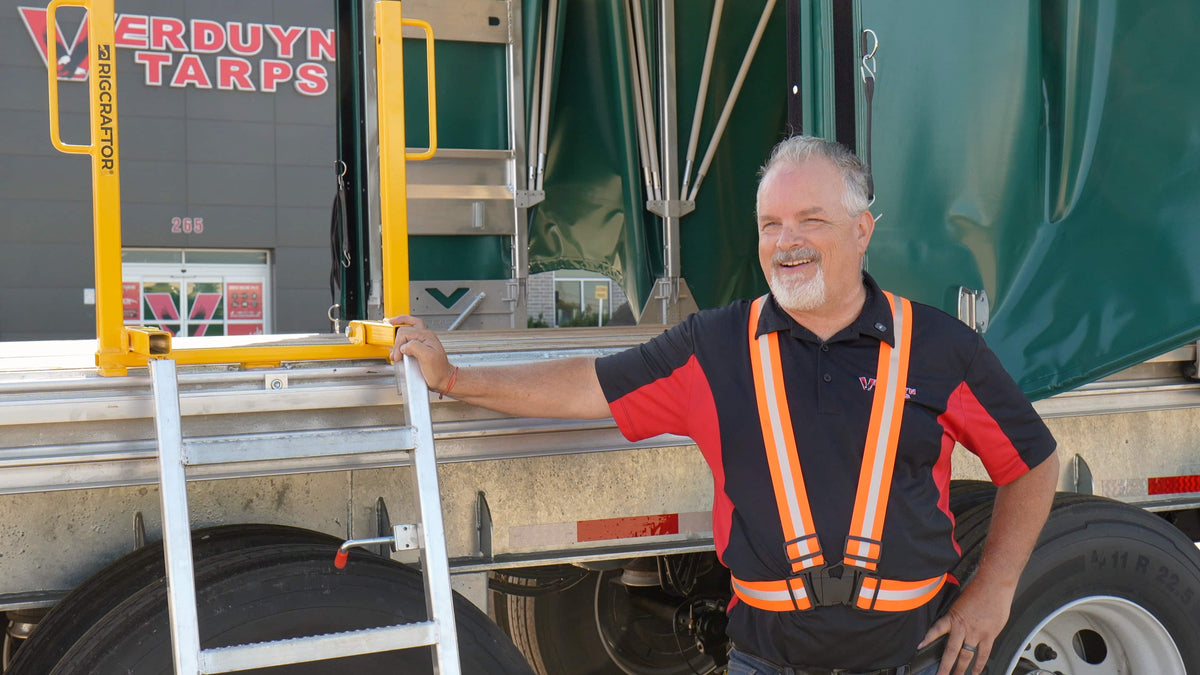
"The best kind of safety feature is a feature that doesn't provide any inconvenience or extra work."
Dan Bethune, Quality Manager, Verduyn Tarps,
At a glance
-
Company: Verduyn Tarps Inc.
-
Industry: Tarping systems and flat deck trucking equipment
-
In business since: 1986
-
Challenge: Drivers running tarp systems had no safe, practical way on and off the deck. Any ladder that hung on the side rail had to come off before the system could close.
-
Solution: RigCraftor Foldable Ladder, available through Verduyn Tarps
-
The result: Three points of contact getting up and getting down, with nothing to remove, store, or work around.
The Challenge: The climb nobody engineered
Verduyn Tarps has spent four decades solving one half of the flatbed problem. Their tarp systems get loads covered faster and keep drivers off the deck while doing it.
But the deck still has to be reached. Loads need checking, straps need setting, and equipment needs moving.
That climb has never had a good answer:
-
It's often blind. The driver reaches for a foothold they can't see, on a surface they can't inspect first.
-
Coming down is worse than going up. Descending backwards on an improvised route is where the falls happen.
-
Winter turns every surface into a hazard. Ice on a rail or a tire is not a foothold, but it's frequently the only one available.
None of this is a driver problem. It's an equipment gap. When the only route up is a tire and a rail, that's what gets used.
Ladders existed. They just came with a trade. A ladder that hangs on the side rail has to be removed before the tarp system closes, which means it needs a place to live, and one more thing to handle at every stop. Equipment that costs the driver time gets left in the side box. Equipment left in the side box doesn't prevent anything.
The Solution: A ladder that stays put
The RigCraftor Foldable Ladder inserts directly into the trailer's stake pocket and locks with a latch at the base. It folds down for use and folds up out of the way.
-
It stays installed. The ladder does not need to be removed before closing the tarp system, and it does not interfere with the sliding mechanism.
-
It needs no storage. No dedicated spot in the side box, no strapping it down, no handling it at every stop.
-
Three points of contact, both directions. Straight-on access with a stable frame, going up and coming down.
-
It clears the side rails. Deployed, the ladder sits clear of the rail rather than hanging off it.


That last set of details is the whole design argument. A safety tool that adds a step to the workflow is a safety tool that eventually stops getting used. This one adds nothing.
The Result: Safety with no tax on the driver
For drivers running a tarp system, the choice between a safe climb and a fast one no longer exists. The ladder is already there, already mounted, ready when the deck needs reaching.
No slips. No falls. Three points of contact, and a safe return to the ground.
For Verduyn Tarps, it completes the picture. Their systems handle the load. The ladder handles the driver.
As Dan puts it:
"If you have a tarp side system and you have challenges getting up and off of that system, this is going to save injury. It's going to make people safer."
Why the partnership works
Verduyn Tarps was built in 1986 on quality, honesty and service, and the company has run on the principle of continuous improvement ever since. RigCraftor was started by a flatbed driver who got tired of watching the job wear people down.
Two companies, one standard: build it tough, build it safe, and never cut corners on the people who depend on it.

>> Explore the Foldable Ladder
Share:
Safer Flatbed Access with the RigCraftor Foldable Ladder