

Truck orders stalled in September. Freight didn't dry up. Fleets stopped ordering because no dealer can give them a firm price for 2027.
Here's why, and what it means for your budget.
The price depends on a rule that isn't written yet
A fully compliant 2027 engine should cost $8,000 to $12,000 more than one today.
If an engine maker can't meet the standard in time, Washington would let them sell anyway and pay a penalty per engine. In that case, what lands on your invoice is closer to $6,000 or $7,000.
Five thousand dollars a truck. On a 40 unit replacement cycle, that's $200,000. Nobody approves a budget with a swing that wide.
What's settled, and what isn't
The 2027 NOx target isn't moving. The EPA has been clear about that.
What's moving is everything around it. Three changes proposed last summer hit your wallet directly:
- The emissions warranty would drop back to 5 years or 100,000 miles, instead of the 10 years or 450,000 miles planned.
- Engine makers could sell non-compliant engines and pass you the penalty.
- How the engine behaves when DEF runs out would change.
None of it is in force. Until the final version publishes, these are proposals.
Keeping your trucks has a price too
Facing an unknown number, most fleets keep what they have. That's defensible. It also has a number attached.
ATRI puts maintenance and repair at 21.5 cents per mile in 2025, up 8.6 percent in a single year. On a truck running 100,000 miles a year, the maintenance bill goes from about $2,000 in year one to $16,500 by year six.
On one side, a premium you pay once. On the other, a curve that climbs every year you wait. Both numbers belong in the same calculation. In most fleets, only one of them is.
Five questions to ask before you sign
1. "That price, is it for a compliant engine or a penalty engine?"
The gap between the two is $5,000 a truck. Get it written on the quote. A quote that doesn't say which one you're buying doesn't commit you to anything, but it doesn't commit the dealer either.
2. "My emissions warranty, how many years and how many miles?"
If the change goes through, it drops to 5 years or 100,000 miles. At 120,000 miles a year, your truck is out of warranty before its first birthday. Ask what the extension costs now, not at delivery.
3. "If the rule changes before my truck is built, what happens to the price?"
Get the clause in writing. Is the price locked? Can it only go up? Can you walk without penalty if the gap exceeds a set percentage?
4. "When exactly does my truck come off the line?"
A slot that slides from December to January can move your truck from one set of rules to another. Get the date and the terms if it slips. Get them on the purchase order.
5. "What does the engine do when DEF runs out?"
Ask how the power loss kicks in, and what the driver sees coming before it does. This is a question about uptime and about keeping drivers, before it's a technical question.
The second cost of keeping your trucks
We put a number on maintenance as a truck ages. There's a second bill. That one isn't on any spreadsheet.
If you keep your equipment two or three years longer than planned, your crews climb on it two or three years longer. Twenty, thirty times a day. On steel that ices over by November.
That wear doesn't show up in your maintenance costs. It shows up in turnover. And in the knees of people you won't replace easily: in April 2026, Trucking HR Canada counted 9.2 percent fewer job seekers in trucking than a year earlier.
The difference from the engine price is that you can act on this bill right now. Without waiting on a final rule.
Three things to do in the next 60 days:
- Walk your yard at shift change. Count how many times someone climbs up by a tire or hauls themselves up by the arms, because the proper handhold is on the other end of the trailer.
- Put the price of access equipment next to what one resignation costs you. The equipment is a fixed cost. A resignation isn't.
- Try before you buy. A supplier confident in the product will leave it in your yard long enough for your crew to make up their minds.
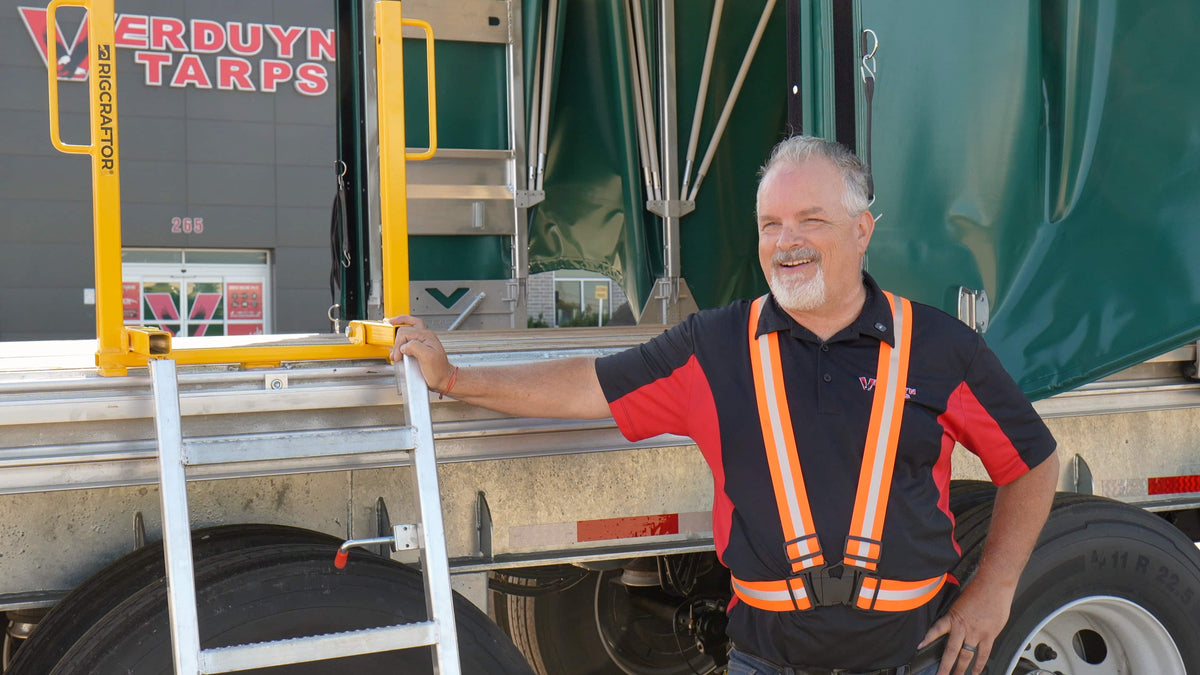
RigCraftor's engineering team builds ladders, strap launchers and hooks that mount on the trailers you already own. No modification to the trailer, no change to how the load gets built.
Washington decides what your next truck costs. You decide the rest.
Sources: EPA proposed amendments to the 2027 heavy-duty NOx standard (2026); American Transportation Research Institute, Analysis of the Operational Costs of Trucking, 2026 Update; Trucking HR Canada, April 2026. Figures in US dollars.


Share: