

Estimated reading time: 3 to 4 minutes
In many cable transport operations, the challenge is not only loading the coils. The real challenge is keeping them stable, aligned, and compliant all the way to the destination.
That is exactly where the Cable Coil Support, also known as the Cable Coil Load Securement Frame – SUP01, came from.
At RigCraftor, we had shared a simple message with our customers: bring us your field challenges. One of them involved the transport of stacked cable coils. The challenge was clear: even when properly secured with straps, the coils remained unstable, could shift during transport, risked falling off the pallet or trailer, and sometimes arrived on site with non-compliance issues that caused significant delays and costs.
RigCraftor therefore designed a dedicated solution to prevent this movement during transport.
The real problem: stacked coils that move during transport
Cable coils are often stacked on pallets before being loaded onto a trailer. In theory, strapping should be enough. In practice, that is not always the case.

The problem identified by RigCraftor was very specific:
-
stacked coils are unstable
-
they can move during transport
-
they risk falling off the pallet or trailer
-
they can arrive at the jobsite with non-compliance issues that delay deployment and increase costs
In other words, the challenge was not to “strap better.” The challenge was to stabilize the coil column itself.
A customer challenge turned into product innovation
RigCraftor’s development approach is clear: many of its products begin with an issue raised directly from the field. One of the company’s industry documents states it very simply: a team shared a problem related to safely transporting large cable coils, and RigCraftor then designed the support that solved that problem.
Essential network operations create pain points. RigCraftor designs the solution.
The Cable Coil Support fits exactly into that philosophy. It is not a product imagined from a distance. It is a direct response to a very real operational constraint.
The solution: the Cable Coil Load Securement
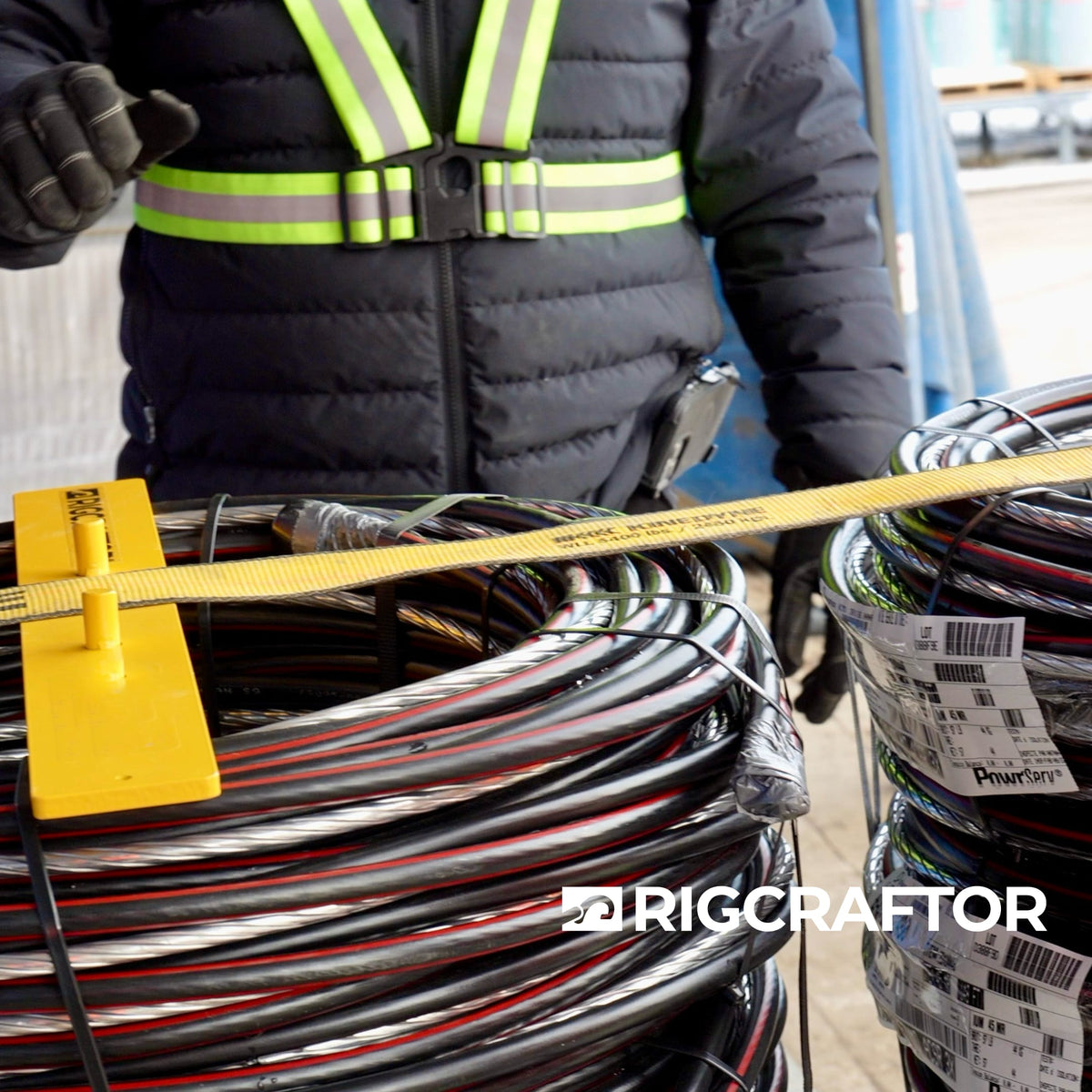
RigCraftor describes the SUP01 as a solution designed to provide complete stability to a column of stacked cable coils during strapping and transport. Its role is to prevent the movements that can occur even when straps are already in place.

Its main features are:
-
horizontal and vertical stability
-
U-shaped stabilizer inside the column
-
2 strap direction guides to keep the strap in place during transport
-
100% aluminum structure
-
lightweight design: 3.5 lb / 1.6 kg
-
safety yellow finish for easy visibility in the field
This design follows a simple principle: control the coils more effectively without unnecessarily adding weight to the operation.
Why this product matters
The Cable Coil Support is not just about organizing a load more effectively. It helps reduce risk, protect material compliance, and avoid wasted time in the field.
In RigCraftor’s documentation, the problem to solve is described as preventing stacked coils from moving during transport and making sure they remain perfectly stable during strapping.
That is what makes it a strong field product:
-
it responds to a specific pain point
-
it reduces improvisation
-
it improves load control
-
it helps secure an operation that could otherwise create delays, rework, and additional costs
In summary
The Cable Coil Securement was born from a real customer challenge: how to transport stacked cable coils without having them move, become misaligned, or arrive non-compliant at the jobsite.

RigCraftor met this challenge with a simple, lightweight, and precise solution designed to stabilize the load, guide the straps, and reduce risks during transport.
When a customer shares a field problem, RigCraftor does not simply comment on the problem.
RigCraftor works to solve it.
🔗 Submit your own challenge to RigCraftor

Share: