

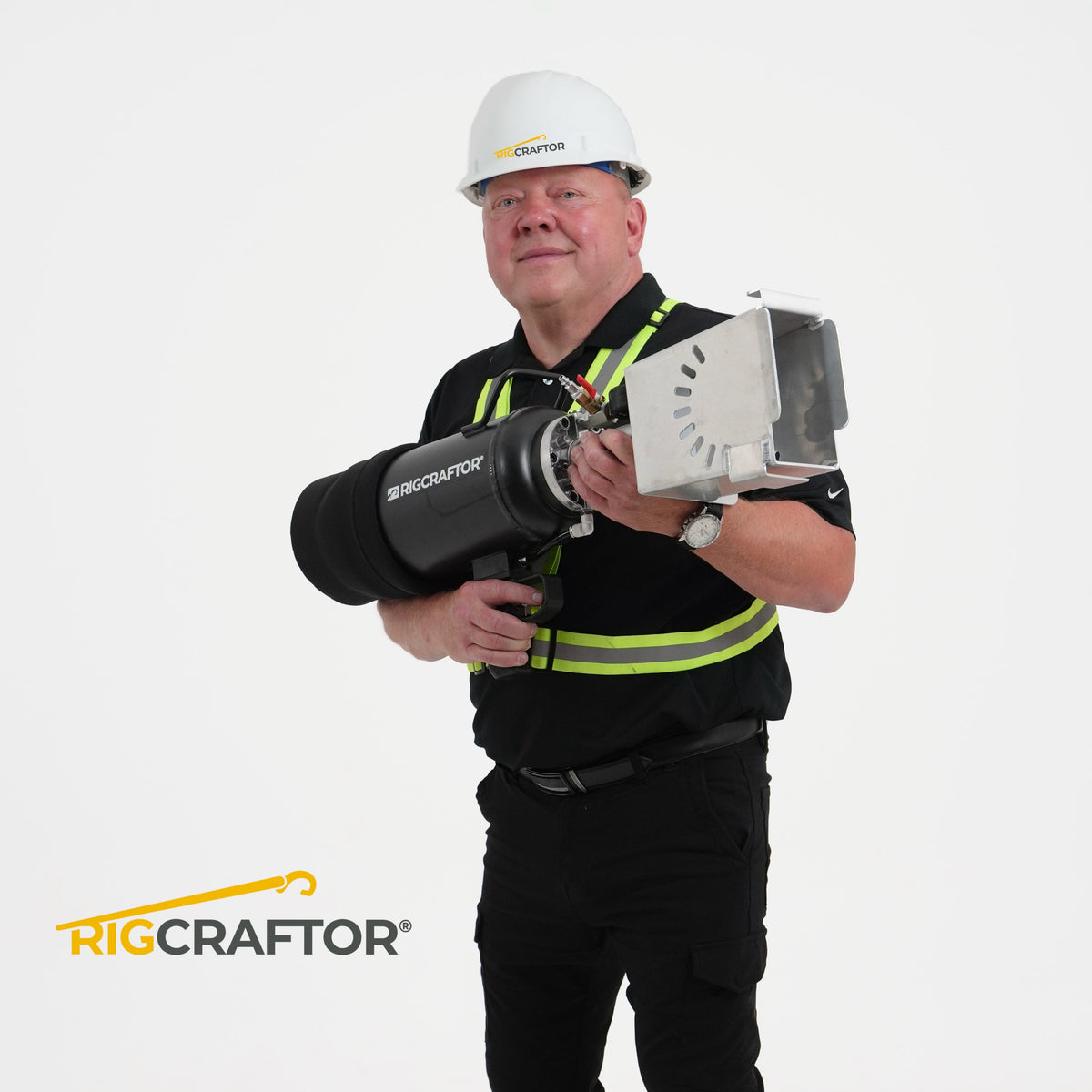
There are tasks in trucking that seem “normal” simply because they have always existed. Throwing straps is one of them. A simple motion at first glance, but one that becomes demanding when repeated day after day, often without any warm-up, sometimes in cold weather, with elevated loads and very real physical demands. Marc Dion summarizes the root of the issue in one word: repetition. A repeated movement involving several pounds being thrown overhead, performed multiple times per day by drivers who are not always warmed up after hours of driving. Under these conditions, the risk of injury inevitably increases.
The real problem: a physically demanding, repetitive motion
According to Marc, in certain operations, truck drivers handle multiple straps 3 to 4 times per day. Several factors contribute to the risk:
- Height (up to approximately 14 feet);
- Weight (the chain at the end of the strap can weigh up to 3.5 lbs);
- The effort required to properly throw the straps;
- The real-world context: driving, stopping, loading, and immediate action without any warm-up.
The risk, according to Marc, is that after several hours behind the wheel, the body is cold and then suddenly shifts to sustained and repetitive physical effort. That’s often when injuries occur, not to mention that straps must also be rolled and tightened to secure the load.
-
The spark: “invent something for us”
This story did not begin in an office.
Marc explains that the impulse first came from the field: truck drivers asked him to invent a solution to avoid “wearing out their arms” and reduce injuries.
He also mentions a case that shaped his thinking: a woman who loved the profession but was unable to efficiently perform certain strap-handling tasks. According to Marc, this physical limitation even affected her ability to be hired. For him, the message was clear: if the profession wants to attract more diverse profiles or retain drivers longer, it needs tools adapted to these realities.
Twelve Years of Development: From Manual to Pneumatic
Marc dates the beginning of this evolution to about 12 years ago. The first versions were heavier: a two-piece aluminum handle—strong, but heavy. Functional, but imperfect. The objective was clear: find the right balance between strength, lightness, and durability.
That’s when the tool began evolving through iterations: lightening without weakening, reinforcing vulnerable areas, testing, breaking, adjusting, and starting again. Marc explains that at one point, certain configurations were breaking. He tried adding internal reinforcements (“rods”), but it wasn’t always enough. A durable combination had to be found.
Why the Multi-Use Head and Bucket Appeared
The multi-use head and the bucket are not aesthetic details. They are responses to a specific need.
Marc explains that some users still found the tool demanding when throwing the strap “with the chain.” By rolling the strap and placing it in a bucket, the effort decreases: what remains is primarily a more controlled guiding motion.
The idea: reduce what carries weight, simplify the gesture, and make the action more accessible, particularly for those with physical constraints.
The Pneumatic Breakthrough: Air as a Stable Force
The shift to a pneumatic system came from a simple observation and an encounter with an existing tool. Marc explains that he saw an air tank originally used to provide thrust in a mechanical setting. He realized that this principle could serve as a foundation—not to complicate the gesture, but to make the thrust stable, repeatable, and less dependent on physical strength.
But adapting this principle to strap throwing was not automatic. According to Marc, one of the major challenges was the angle: without the right angle, the air creates a cushion that does not push correctly. He states that he went through about ten tip iterations, adjusting and testing until the right geometry was achieved.
Safety: “like a firearm, it needs a safety mechanism”
Marc emphasizes one key point: when air propulsion is introduced, safety becomes the top priority. He therefore integrated a safety mechanism based on a simple principle: an action must never be able to be triggered accidentally.
He describes a dual-action system: a safety lock must first be engaged, then the trigger pressed. Without the first step, the second produces no effect. He compares this logic to a form of double confirmation—the objective is to prevent any accidental activation.
An unexpected field effect: “twisted” straps
Marc also mentions an operational issue that is rarely discussed: some straps become twisted when thrown manually. In winter, a poorly positioned strap quickly becomes a major constraint. According to him, one of the advantages of the pneumatic system lies in a more precise launch, preventing the straps from twisting and ensuring they lie flat every time.
Why it has a future
Marc clearly distinguishes between two profiles:
Those who prefer the manual strap launcher
Those who will benefit from the pneumatic version
But on one point, he is clear: with an aging workforce, demand will increase. According to him, once a user adopts a tool that reduces effort and secures the motion, they have no desire to go back.
An innovation born from a gesture normalized for too long
This story is not about a catalog product. It is about a movement repeated, normalized, and accepted for years—until truck drivers themselves asked for a different way. The pneumatic strap thrower was born from a very simple sequence:
-
Real problem
-
Field listening
-
Prototypes
-
Trial and error
-
Safe solution
→ Discover how to reduce strain on your shoulders starting today

Share: